Showing posts with label Guides. Show all posts

Wednesday, 5 October 2011

Harmony, Lifebloom, and You! (with logs!)

My doodle of how I imagine my tree healing :D
Inspired by the ever funny Allie Brosh from Hyperbole & a Half

I wanted to devote a post to Harmony (our Mastery) and Lifebloom as I’ve found many druids (whether mains, offspecs, or alts) were not realising the value of these things, not maintaining good uptime on them, or both. These two things are extremely important to druid healing. Lifebloom especially is crucial to our mana regen (from Revitalise procs), to our clearcasting (as, for Resto druids, Lifebloom is our only ability which grants Omen of Clarity for our healing spells), and to our groups, as Lifebloom provides Replenishment for our party or raid.
For anyone wondering what I mean by uptime - uptime is referring to how much the ability or buff is active throughout a fight. So, for a quick example, if you maintain Lifebloom up perfectly through an entire fight, the uptime would be 100%. If you only had it up for half the fight, it would be 50%. 
Ideally, both Lifebloom and Harmony will have an uptime of 100%. In actuality, it will vary a little bit; for example, on the Alysrazor encounter, when Alysrazor crash lands there is no damage going out until she takes off again. Healers in this period are all DPSing both to help damage her and also for the mana return from DPSing her in this phase. During that period you won’t be maintaining Lifebloom or Harmony as you’ll be busy DPSing. The end uptime percentage on these abilities for that fight will be below 100% as it simply isn’t in the mechanics of the fight. Now, compare that fight to, say, Baleroc, where the primary healing is all big direct heals on the tanks and Shards of Torment soakers. This is a fight where it’s pretty easy to get 98%+ uptime on both Lifebloom and Harmony.
Keeping context of the specific fights in mind, a practical uptime for both Lifebloom and Harmony should be between 80% and 100%. You should always aim to be as close to 100% as possible.
Harmony 
Harmony, the Resto Mastery: Your direct healing is increased by an additional x% and casting your direct healing spells grants you an additional x% bonus to your periodic healing for 10 seconds.
Your direct healing spells (Nourish, Healing Touch, Regrowth, and Swiftmend) proc a buff called Harmony - this buff lasts for 10 seconds and boosts your HoTs by x% (based on how much mastery you have).
This is extremely important to maintain as it strengthens your HoTs. This is especially important while raid healing - many druids simply fall into the Rejuv, Rejuv, Rejuv, Wild Growth! spam while raid healing and forget about their direct heals entirely, or just think that because they’re on raid they shouldn’t use any other spells. Unfortunately this results in you gimping your own HoTs (as well as wasting an arsenal of useful healing spells). If that buff isn’t active, your HoTs have no benefit from your Mastery (and yes, that buff needs to be active before you cast the HoTs). Harmony needs to be active for your HoTs to be as strong as possible.
As I mentioned above, fights like Baleroc or Shannox with a lot of single-target healing focus are a bit easier to maintain good Harmony uptime. Fights with heavier raid damage such as Beth’tilac or Lord Rhyolith tend to be more difficult to maintain good uptimes for as you have to balance weaving in your direct heals with your raid healing.
Swiftmend counts as a direct heal and will proc Harmony, so if you’re really pressed to maintain the buff you can use Swiftmends to help activate the buff and, while SM is still on cooldown, through in a quick Nourish, Healing Touch, or Regrowth to keep Harmony active until SM is ready to use again.
5 man dungeons are probably the easiest place to maintain good Harmony (and Lifebloom) uptimes, as there’s plenty of direct healing to do on the tank (and sometimes on the DPS as well!). You can easily keep it active even when the tank isn’t taking much (or any) damage - simply toss a Nourish on him; it will refresh your Lifebloom stack and activate Harmony for next to no mana cost.
Using Nourish to activate Harmony and refresh Lifebloom is also a great thing to do pre-pull, whether in 5 mans or in raids. The mana cost is negligible and both the Replenishment and Revitalize procs from your Lifebloom will restore the mana quickly. It ensures you go into the start of the fight with Harmony active (which is especially helpful if AoE damage starts right away, so you can spread some HoTs immediately). 
Lifebloom
Lifebloom! Lifebloom is one of our most important spells. It is crucial to keep Lifebloom up whether you’re healing a 5 man dungeon, a 10 or 25 man raid, a heroic raid, or PvP.
Lifebloom in Cataclysm plays a central role in our mana regen and management as well as being a healing tool.


Lifebloom procs Revitalize, which grants us mana. 
Lifebloom also is the ONLY way to get Omen of Clarity procs for healing. None of our other healing spells will proc OoC/Clearcasting. We have to spec into Malfurion’s Gift in order to enable our Lifeblooms to provide OoC. If your Lifebloom uptime is low, you won’t have as many clearcasting procs from Omen of Clarity, which means you won’t be able to cast spells with no mana cost. This will seriously hamper your mana over the course of a fight!
Lifebloom also supplies Replenishment for you and your party or raid - Replenishment grants up to 10 party or raid members mana regeneration equal to 1% of their maximum mana per 10 seconds. This is important both for you and your group! Replenishment helps your fellow healers and your casters. This also makes maintaining Lifebloom even more important in 10 and 25 man raids if you only have a few classes in your group who can provide Replenishment. if you are the only person in your 10 man group who can provide Replenishment and your Lifebloom uptime (and hence, Replenishment procs) is low, you are severely limiting Replenishment for your fellow raiders. Similarly in a 25 man group, if there are only a few of you providing Replenishment, you can be preventing your fellow raiders from having Replenishment, as each class’ replenishment only affects up to 10 people. So a Resto druid could provide Replen for an entire 10 man raid but you would need 2 or 3 Replen providers to cover a 25 man raid (possibly only 2 as your non-mana users won’t need it).
Lifebloom tends to be a bit easier for people to maintain than Harmony, as most seem secure with having to maintain a stack of 3 on their tank. It can also be refreshed quickly if needed by simply recasting it on the tank, though it’s best to refresh it with at least a Nourish (if not Regrowth or Healing Touch) when you can while raid healing so that you activate Harmony as well.
It’s also good to get into the habit of always having Lifebloom up, and 5 mans is a great place to practice it - always keep it up, even through all the trash! Some may be surprised to hear me suggest that, but I’ve seen many druids in 5 mans only putting Lifebloom on their tank on boss fights. Keeping Lifebloom up and maintaining it, even just with lots of Nourish casts when your tank is taking little to no damage, will go a long way in helping ingrain the habit of keeping it up. It will also keep your tank topped off, especially with the Nourish casts in between heavier damage portions (and will keep Harmony active!). The Replen and Revitalize procs will also help restore your mana between trash pulls and bosses, so less time spent drinking!
Again, as suggested in the Harmony section, it’s good to get your 3 stack of Lifebloom up pre-pull, and just refresh it into the pull with Nourish to proc Harmony. Also, if you’re lucky enough to get Dark Intent, your warlock will love you as all the Lifebloom ticks will give him a full 3-stack of his Dark Intent buff pre-pull! 
I should also note: Maintaining Lifebloom is absolutely crucial as I’ve mentioned. There are times, however, when you may be unable to stack Lifebloom on your tank - you may be positioned out of range, for example. In cases like this, stack Lifebloom either on yourself or on another suitable target (if you’re focussing a specific DPS, perhaps a broodling soaker on Beth’tilac, you could stack Lifebloom on them). You can always move the stack back to the tanks when you’re back in range. You absolutely must keep Lifebloom up at all times though.
Analyzing Logs: Harmony and Lifebloom
Logs are the best place to see how you’re doing in terms of maintaining good Lifebloom and Harmony uptime. Whether you’re looking to improve on your own healing, evaluating a new app for your guild, or helping a friend, Logs are extremely helpful all around for analysing your healing.
World of Logs is where tons of Logs are uploaded by guilds for analysis. It can be a bit confusing at first if you’re not familiar with it, so here’s how to navigate to the information we’re looking for. With pictures! You may have to click the screenshots to get a better view.
Here’s a log for one of our nights last week. This is the Dashboard page, where you’ll be brought to first when selecting a night’s logs. To look at a specific player, use the drop-down menus: Here I’ve gone to Players > Druid > Derwent.
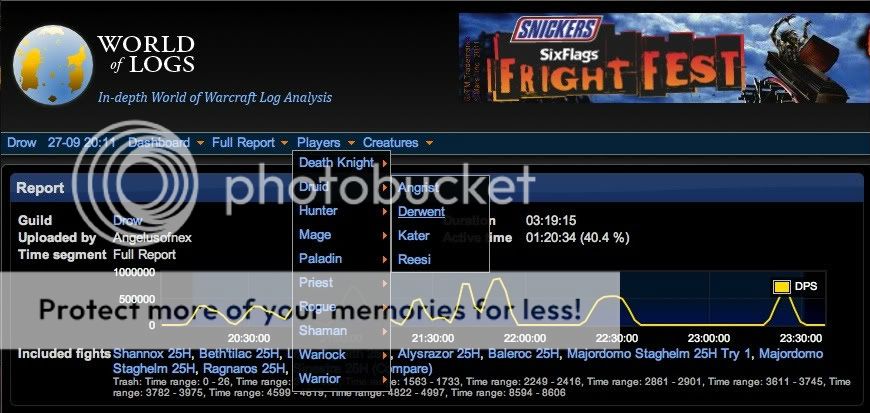
For looking at Lifebloom and Harmony uptimes in particular, you should really look only at Boss fights during raids. Looking at the full report can really skew the data - the person you’re looking at might have been AFK or outside the instance during some of the trash mobs, or they might have been DPSing for some of the fights, or perhaps were swapped out for another raid member for some fights. It’s best to look either at Bosses (to include all of them) or to go to specific bosses and look at them one by one. The time in parenthesis by each boss name is the length of the kill, and an arrow off of any bosses will show multiple attempts/wipes on that boss if it wasn’t killed the first time.
Here I’ve gone to Full Report > Bosses > Ragnaros 25H.

Once you’ve gotten to a specific player and a specific boss, you can then go through the tabs to get more information. For Harmony and Lifebloom in particular, it’s best to look at Buffs Cast. This will bring up the following screen:

On the left are the Buffs I cast throughout the fight. You can see Mark of the Wild up at the top at 100% uptime - a static buff of course on the entire raid throughout the fight. Next up is Lifebloom, up at 87.2%, and Harmony at 82.6%. Could be higher, particularly my Harmony which I’ve maintained higher in our other kills, but still good and realistic given some of my other duties in the fight (I do meteor knockbacks in phase 3, Stampeding Roar in phase 2, plus the brief RP time before phase 4). Context is of course important, but you’re still always shooting for that ideal of 100% uptime.
For interest’s sake, we can scan down the rest of the Buffs there. My Power Torrent procced 16 times throughout the fight, giving it a 25.5% uptime. I had 27 Clearcasting procs throughout the fight from my good Lifebloom uptime. I used Tree of Life 3 times, Barkskin 8 times, Innervated myself 4 times. I used Cat Form 3 times along with 3 Nature’s Swiftness casts, and I even Shadowmelded once! (It tends to help me avoid aggro from the scion spawn in the second intermission).
Moving to the right, you can see my Debuffs cast - Exhaustion from Heroism, I cast Moonfires on the Meteors I was knocking back, and Concentration from a Concentration Pot.
Moving to the right once more, you can see Power Gains - this is the mana I gained throughout the fight. Reviltalize and Innervate gave me back the most mana. Heartfire is the Resto t12 2-piece bonus, which is a pretty good mana return throughout the course of a fight. Replenishment there is how much my Replenishment provided to the raid - to see how much you yourself gained from Replenishment, simply click the Buffs Gained tab, shown below, in which you can see the mana gained from Replen (and also from a Concentration pot). 


That all is also looking at a fight which was 12 minutes long - some numbers will be lower for shorter fights.
Some Examples
Here are just a few more examples of some logs looking at Harmony and Lifebloom uptimes.
The following log is one from a Baleroc kill. As I mentioned earlier, because of all the 
direct healing required in this fight, this is a much easier fight to maintain near-perfect Lifebloom and Harmony uptime. You can see there’s a 98% uptime for Lifebloom and 96.6% uptime for Harmony.

I also found the following two logs from kills of Lord Rhyolith - both kills were about 4:40 in length. This is a good comparison of the same encounter, the same length of time, and the effects of high and low Lifebloom uptime in particular.
If you look at this first log, you can see Harmony uptime is up at 92.2% and Lifebloom uptime is up at 87.1%, good. If you look just below that you can see Clearcasting (Omen of Clarity) procs: 21! If you look over to the right for Power Gains, you can see Revitalize restored 66,639 mana.
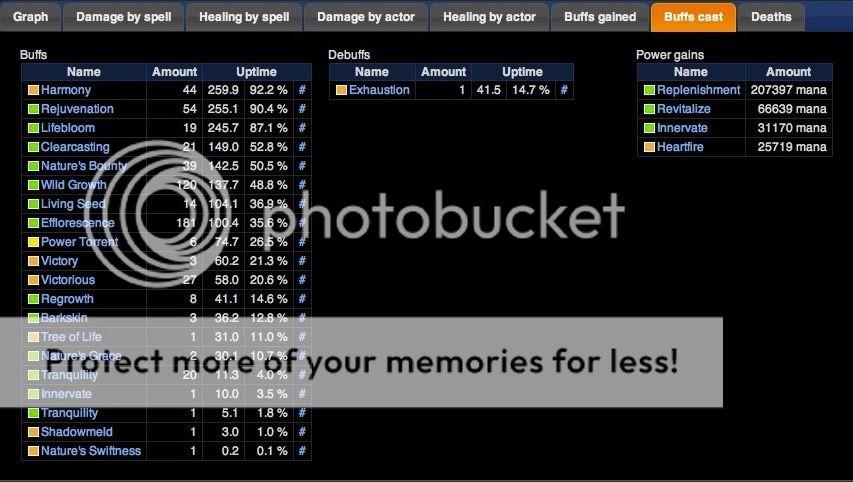
If we compare that with the following log, you can see Harmony uptime in this log is low at 49.5%, and Lifebloom is only at 31.4% uptime. This also resulted in significantly lower Clearcasting procs - only 8! That can really add up over the course of a fight. If you look to the right, you can see their Revitalize only provided 49,874 mana. While that’s not too low (Rejuvenation also procs Revitalize, which helps there, and the size of each druid's mana pool does factor in as well), that’s still a disparity of 16,765 mana. 

So as you can see, good Lifebloom uptime is really important for mana as well as healing!
I’ve certainly rattled on enough, so I think I'll wrap it up here. Remember, good Harmony and Lifebloom uptime is important and, as ever, practice makes perfect! Don't be discouraged if you're a bit low to start with - just keep working at it and it will improve.

A good tracker for Harmony and Lifebloom can also go a long way! I have some useful Power Auras for keeping an eye on those (full details in my My User Interface / Addons post!) which may be of help to you - the Harmony one in particular displays when the buff is active and has a timer to show you how long is left on it. Many of you likely have some means of watching your HoTs on targets to keep an eye on your Lifebloom, but if you like you can also use the little power aura to show you when your Lifebloom is active as well (this aura does NOT show stacks or timer for Lifebloom, though).


Harmony Power Aura:
Version:4.22; b:0.0549; g:0.4863; icon:Spell_Nature_HealingWay; buffname:Harmony; r:0.1843; x:-85; customname:Harmony; texture:23; alpha:1; inVehicle:0; wowtex:true; combat:true; size:0.25; y:-160; texmode:1; ismounted:0; timer.b:0.9294; timer.h:2; timer.Texture:WhiteRabbit; timer.enabled:true; timer.r:0.9882; timer.cents:false; timer.Relative:CENTER; timer.UseOwnColor:true

Lifebloom Power Aura:
Version:4.22; icon:INV_Misc_Herb_Felblossom; buffname:Lifebloom; x:-45; customname:Lifebloom; alpha:1; mine:true; inVehicle:0; groupOrSelf:true; customtex:true; combat:true; size:0.1; y:-115; ismounted:0

Simply copy, open up Power Auras, hit 'Import' and paste the code into the import bar!
Happy healing!

Monday, 27 June 2011

4.2 Resto Changes and You!

Patch 4.2 is finally upon us and should be landing this week! There are plenty of changes and new content coming, including the new Firelands raid zone! For the latest news and updates I suggest checking out MMO-Champion.

I'll be updating my Resto and Feral guides over the course of this week. For the moment though I'd like to focus on two important changes for Resto: The Innervate changes and the new Mastery.

Innervate in 4.2


Innervate is undergoing a change in 4.2, but it's important to fully understand this change.


Innervate used on oneself is unchanged.

When the casting druid uses Innervate on his or herself, the druid will still receive 20% of their maximum mana.

The change to Innervate is when it's cast on other targets, eg, the druid casts an Innervate on a Pally. In 4.2, an Innervate will cause a target to receive 5% of their maximum mana pool - so, in the example of a druid casting their innervate on a Pally, the Innervate will give the Pally 5% of the Pally's maximum mana pool. This is a substantial nerf to Resto and Balance druid Innervates (though it's technically a slight buff to Feral Innervates), as apparently sharing Innervates was accounting for too much mana savings, especially at higher gear levels.

So what does this mean for us? Well, you'll be much less likely to be giving your Innervates away, and overall Innervate will be a bit less desired by other healers. An important thing to note is trading Innervates with another Resto druid will no longer be a mana gain - the Innervate you give to the other druid will be substantially less and vice versa, so this is no longer a viable strategy for mana return. For maximum mana gains, you'll want to be Innervating yourself.

Glyph of Innervate
It's very very important this is understood - Glyph of Innervate is unchanged in 4.2. The tooltip has been updated to reflect what this actually means - the casting druid will receive half of their Innervate when they cast Innervate on another target, ie half of 20% of their maximum mana pool, that is to say 10%. This means you will still receive 10% of your maximum mana pool when you cast your Innervate on another target while glyphed.

With that in mind, Glyph of Innervate is still a useful glyph in 4.2. While your Innervate won't be as valuable to others as it is currently, it can still be extremely useful for people, especially if a fellow healer is out of mana (or perhaps was just battle rezzed), or even for a DPS that could use it. Balance druids can also still help out their healers with an Innervate. The nice thing about continuing to use this Glyph is it gives you the flexibility to share your Innervate with someone else should they need it while still receiving some of the mana return yourself.

New Resto Mastery


I discussed the new Resto Mastery some already in an earlier post, but I wanted to refresh on it with 4.2 finally going live. Our new mastery is the following:

Harmony: Increases direct healing by 10% and your direct healing spells grant you a 10% bonus to your periodic healing for 10 sec. Each point of mastery increases each bonus by an additional 1.25%.

This is a really nice change for Resto druids, increasing our direct healing and making a nice interaction between our direct heals and our HoTs. Every time we cast a direct heal (Healing Touch, Nourish, Regrowth, and also Swiftmend), we will gain the buff Harmony which increases the healing done by our HoTs.

We ideally want to maintain as close to 100% uptime on the buff as possible. It will be very important for raid healers to make sure they're maintaining the buff to increase their HoTs as well as the tank healers. Swiftmend will proc the buff, but the cooldown on Swiftmend is 15 seconds and the buff remains active for 10 seconds, so you'll be losing uptime on the buff if you only refresh it with Swiftmend. It's reasonable, but ideally you won't be losing any uptime at all. If you're largely raid healing, you're still likely keeping your Lifebloom rolling on the tank or another person, so refreshing it with a Nourish or other direct heal should help you maintain the buff. Tank healers and those who watch both shouldn't have too much issue maintaining the buff.

Keeping track of the Harmony buff will go a long way to helping you maintain good uptime on it. For those that use the addon Power Auras (an excellent addon which I highly recommend), the following is a code I made which is helpful for keeping track of the mastery buff. It will show you the buff is active and the time remaining on it so you can see when you need to refresh it.

The import code is this:
Version:4.19; b:0.0549; g:0.4863; icon:Spell_Nature_HealingWay; buffname:Harmony; r:0.1843; x:-85; customname:Harmony; texture:23; alpha:1; inVehicle:0; wowtex:true; combat:true; size:0.25; y:-160; ismounted:0; timer.b:0.9294; timer.h:2; timer.Texture:WhiteRabbit; timer.enabled:true; timer.r:0.9882; timer.cents:false; timer.Relative:CENTER; timer.UseOwnColor:true

The Aura itself looks like this (seen with my full Resto power aura setup):

The Harmony aura is the leaf on the left hand side with the timer.

My full set of power aura codes are available in my post here: My User Interface / Addons.

Happy patch day! Don't forget to update your addons!

Saturday, 30 April 2011

Raid Encounter Guides - Sinestra (Bastion of Twilight)


Sinestra, Consort of Deathwing, is the optional, Heroic-only end boss in the Bastion of Twilight. To even reach her you must kill Cho’gall on Heroic mode, which opens a trapdoor down into the deep cavern where Sinestra dwells with her eggs.
The Sinestra fight is both fun and challenging. The DPS check is extremely tight, which in turn makes the healing check fairly tight as well, as you will be hard pressed to run more than 5 or 6 healers. You will only need 2 tanks. Your healers will need to be able to dispel magic.
I’ll break this guide down into an Ability list, a simple breakdown of the phases, then a detailed look at some of the more critical aspects of the fight.
Abilities
Mana Barrier - Envelops the caster in a powerful barrier that continually replenishes any lost health, at the expense of the caster’s mana.
Flame Breath - Deals 95000 to 105000 Fire damage to all enemies in front of the caster.

Twilight Blast - Blasts an enemy for 166250 to 183750 Shadow damage
Wrack - Deals increasing Shadow damage over one minute. When dispelled bounces to two nearby allies of the afflicted player.

Twilight Slicer - Beam of concentrated twilight energy, dealing 50,000 Shadow damage every 0.3 seconds to any enemy in contact with it.

Twilight Pulse - Deals 27000 to 33000 damage every 0.5 seconds to enemies within 10 yards.
Twilight Extinction - Deals 475000 to 525000 Shadow damage to all enemies within reach.
Whelps
Twilight Spit - Spits Twilight energy at an enemy, dealing 3800 to 4200 Shadow damage and increases Shadow damage taken by 10%. Stacks.
Twilight Essence - Deals 9250 to 10750 Shadow damage to enemies within the bubbling Essence. Dropped by whelps the first time they die; revives any whelps who die within the pool.
Spitecallers
Unleash Essence - Releases a torrent of twilight energy that afflicts all nearby enemies, dealing damage equal to 10% of their maximum health every second.
Indomitable - Regains control through a surge of sheer will, becoming immune to all bonds and restraints until stopped. Deals 40000 Shadow damage to enemies within 10 yards and knocks them back.
Twilight Drake
Twilight Breath - Deals Shadow damage in a frontal cone.
Calen
Fiery Barrier - Protects nearby allies from dark magic, reducing their Shadow damage taken by 99%.
Essence of the Red - The blessing of Alexstrasza is applied to all allies nearby. Restores 5% of maximum mana per second. Grants 100% melee, ranged, and spell haste. Lasts for 3 minutes.
Pyrrhic Focus - Evelops the caster in a fiery aura that continually restores mana at the expense of the caster’s health.
Strategy
Phase 1
When you first engage Sinestra, she is afflicted by a debuff that causes her abilities to do 40% less damage and she begins the fight with 40% less HP. This first phase is primarily a DPS burn - Sinestra needs to be burned from 60% HP down to 30% as quickly as possible, ideally avoiding a third Whelp spawn and a second Wrack.
Sinestra’s primary ability is Flame Breath, a raid-wide AoE attack which she casts every 20 seconds. 
The whelps spawn every 50 seconds and should be picked up by the off-tank. Ideally you want to avoid a third whelp spawn. The whelps tend to aggro onto the healers, so it’s usually best for the OT to position near the healers.
You will get at least one Wrack during this phase. Wrack is a minute long debuff which needs to be dispelled off of afflicted targets well before this duration is up - this debuff applies increasing Shadow damage over time and will kill anyone affected long before the minute is up. When dispelled (or when the target dies, from Wrack or something else), the Wrack will jump to two other friendly targets. Careful control of Wrack dispels is crucial to avoid it getting out of control. It’s usually best to assign one person to handle dispels, with another as backup. Detailed discussion of Wrack is below.
You will also get 2-3 Twilight Slicers in this phase, so your raid needs to be positioned and prepared to deal with those. Detailed discussion of the Twilight Slicers is below.
Raid damage is pretty light in Phase 1 until the first Flame Breath, so any healers not worrying about tanks should DPS as much as they can in Phase 1, at least until that first breath goes out.
Phase 2
Phase 2 begins when Sinestra reaches 30% health. She will cast Mana Barrier on herself, healing herself to full. She will begin to cast Twilight Extinction, so it’s imperative the raid moves quickly to the back of the room to where the friendly NPC Calen has joined the fray. Calen will cast Fiery Barrier, and all raid members must ensure they are inside the barrier, as it will protect them from Twilight Extinction.
The whelps from Phase 1 should be brought to the back of the room with the rest of the raid and AoE’d down in a pile. The dead whelps will create a pool of Twilight Essence when they die the first time which will resurrect them - the respawned whelps need to be picked back up and AoE’d down again, ensuring they die outside of the pool. They will not create a puddle when they die the second time.
There are several things to deal with once the Fiery Barrier drops.
Spitecallers will spawn from the entry tunnel and will largely be handled by your melee DPS and the whelp tank. The Spitecallers will continuously try to cast Unleash Essence, which will very likely lead to a raid wipe if successfully cast, so a careful interrupt rotation needs to be in place. Ordinary interrupts (Kick, Mind Freeze, etc) can NOT be used though - detailed explanation on the Spitecallers is below.
Your range DPS (and possibly some melee) should head back to Sinestra and the two Pulsing Twilight Eggs on either side of Sinestra, the paths to which are no longer protected by fire. The range DPS should be DPSing Sinestra as soon as they can leave the Fiery Barrier to force her to remove the Twilight Carapace which protects the eggs to shield herself. DPS should be split evenly to kill the Eggs the second the Twilight Carapace is removed. DPS needs to be strong and fast to kill the eggs before Sinestra replaces the Twilight Carapace - if the Eggs don’t die before the Carapace is replaced, you will likely wipe. You may want to pot on the eggs to avoid Phase 2 wipes due to slow DPS. You should also try to maximize DPS time on the eggs, predotting while finishing DPS on Sinestra until she removes the Twilight Carapace from the eggs so that you can open full blast and already have DoTs ticking without losing DPS time on the eggs.
There will also be Twilight Drakes spawning in this phase which should be picked up by the Sinestra tank. These can be DPS’d after the Eggs die by the ranged DPS as the raid is getting back into position. The Drakes do a frontal cone but do not do much damage otherwise.
Spitecaller and Drake spawns are somewhat subject to RNG, and there can be a bit of luck involved in how many spawn. Fast DPS on the Eggs can also help to push past late spawns.
Healing is again light in this phase - your two tanks will need healing and a healer can also cast some heals onto Calen (who will be afflicted by Pyrrhic Focus). Unless an Unleash Essence gets off, there will be no other healing needed, so any healers with decent DPS should be assisting on Eggs or Spitecallers (Druids, Priests, and Shaman are generally best, whereas Pallies can remain on the tanks).
Phase 3 will begin when the two Eggs die.
Phase 3
Phase 3 begins when the two Pulsing Twilight Eggs are dead. Finish up any remaining Drakes and Spitecallers as she transitions and return to your Phase 1 positioning.
Phase 3 is the same as Phase 1 in terms of abilities - Sinestra will continue to cast Flame BreathWrack will be going out to the raid, Whelps will spawn, and there will be more Twilight Slicers to avoid.
Sinestra has healed herself to full, however, so she is back to full health and to full ability power - all of her abilities will now be hitting 40% harder than they did in Phase 1. It is imperative raid members be topped off before every Flame Breath or they will die.
To help with the increase in Sinestra’s health and damage, Calen casts Essence of the Red on the raid, granting 100% melee, ranged, and spell haste, and restoring 5% of maximum mana per second. This buff lasts for 3 minutes, and ideally you want to get Sinestra down to at least 20% health when this buff falls off.
Good handling of the whelps in this phase is important, as you will be getting many more waves than in phase 1. You will want to have members turn and kill the whelps before they get out of control to prepare for subsequent waves. It is helpful to have a Paladin as your OT for the whelps, as they can bubble off the stacks of Twilight Spit in between waves. You may also wish to have your OT and MT swap partway through phase 3 for the stacks to fall again.
Wrack must also be kept under good control. As of 4.1, Wrack avoids jumping to tanks, which is extremely helpful in controlling it (as it generally would need to be instantly dispelled off tanks in phase 3).
Wrack
It is crucial the Wrack debuff is appropriately handled throughout Phase 1 and Phase 3. It is generally best to assign one person to handle the Wrack dispels. It is useful for all healers to pick up a magic dispel to be ready as backup should the designated dispeller die or need assistance.
Wrack - Deals increasing Shadow damage over one minute. When dispelled bounces to two nearby allies of the afflicted player. If a person dies with Wrack on them, it will also bounce to two other raid members.
It’s best to keep Wrack on as few people as possible, so timing the dispels well is essential. You will need a way to see how long the Wrack debuff has been on a target for. For those who use Vuhdo, enter Wrack as a custom debuff and ensure ‘Alive Time’ is ticked. For those who use Grid, the addon GridStatusSinestra will monitor it.
The first Wrack of each set applied you ideally want to dispel at around 18 seconds. In Phase 3 especially, you will likely want to cooldown the target, with something like Guardian Spirit. For later Wracks and the Wrack jumps, you will want to dispel between roughly 10-18 seconds, dependent on Sinestra’s Flame Breath timer (particularly in Phase 3), the person’s HP, what class they are (and whether they have a personal cooldown to help mitigate it), what cooldowns are available to them, and how many Wracks are out.
It is extremely helpful to have one of your raid healers focus on healing targets with Wrack to ensure they are getting enough heals and that they are topped off before each Flame Breath.
As of 4.1, Wrack will avoid jumping onto tanks, which is incredibly helpful for managing Wrack. Should Wrack jump onto a tank in phase 3, they will likely need to be instantly dispelled, as the incoming damage will be too great to add a Wrack on top of that.
Spitecallers
The Spitecallers in Phase 2 are tricky adds to deal with. It’s crucial their cast, Unleash Essence, doesn’t get off. Normal interrupts and stuns do NOT work on the adds - if you try to interrupt with Kick, Mind Freeze, Pummel, or stun with a Hammer of Justice, Charge, Death Coil, etc, the Spitecaller will gain Indomitable - Regains control through a surge of sheer will, becoming immune to all bonds and restraints until stopped. Deals 40000 Shadow damage to enemies within 10 yards and knocks them back.
If the Spitecaller gains Indomitable, it will almost certainly get off a cast of Unleash Essence, which will lead to a lot of unnecessary raid damage and very likely lead to the whelp tank’s death (as the stacks of Twilight Spit could lead to a one-shot).
Instead, you need to use controls which break on damage to interrupt the cast. Some you can use are Gouge (Glyph of Gouge is extremely helpful), Blind, Death Grip, Hibernate, etc. (I don't particularly recommend Hibernate, as it has a cast time which is the same length as the Unleash Essence cast).
Gouge is most reliable for the interrupt used. Death Grips can be helpful as the adds spawn - it can whip the Spitecaller away from the entrance point, helping to make the next add spawned easier to target should the first Spitecaller still be up when the new one spawns.
Whelps
Whelps spawn every 50 seconds in Phase 1 and 3. Their main attack is Twilight Spit as well as melee hits, which in itself are not very hard, however the Twilight Spit causes a stacking debuff which increases Shadow damage taken by 10%. As more of these adds are up, the tank handling the whelps will take increasing damage. A paladin tank is very helpful on the whelps as they can bubble off the stacks.
When the whelps first die, they create pools of Twilight Essence, which deals Shadow damage to raid members standing in them and will resurrect any whelps dead in them. The pools are only created the first time the whelps die, so when they resurrect they should be moved outside of the pool to be killed a second time.
The whelps from phase 1 which are killed at the phase 2 transition should ideally be killed in the back as out of the way as possible to ensure the pool is out of the way. In phase 3 the whelp deaths need to also be controlled, ideally the first waves dying towards the back of the room and away from the raid. Generally ranged should be able to turn and kill the whelps when called for it. 
How you kill the whelps (AoE’d down at once or dropped in singles) and after how many waves each time comes down to your raid’s strategy, but ultimately it’s crucial the pools are kept as small and out of the way as possible.
Twilight Orbs/Slicers
Welcome to Cutters 4.0! 
Throughout Phase 1 and 3 Twilight Orbs will spawn and target random raid members. It is extremely important to note: The Twilight Orbs do NOT place a debuff on their targets! The orbs affix to their targets with a thin purple tether. The Twilight Orbs will spawn and within a few seconds tether to their target, then a large Twilight Slicer will connect between the two Orbs and the Orbs will chase their target. 
The two Orbs need to be kited away from the raid such that the Twilight Slicer doesn’t lop anyone’s head off (including the kiters). The two kiters will need to find a way to loop around each other so that they avoid killing each other and get back to their original position quickly to maximize DPS time. 
The Orbs themselves do Twilight Pulse, which deals 27000 to 33000 Shadow damage every 0.5 seconds to enemies within 10 yards, so both raid members and kiters need to get clear of the Orbs. They do not begin pulsing until about 5 seconds after they spawn.
If the tethered person dies for any reason - the Orb will retarget onto a high aggro target, usually a healer. The purple tether will not reappear - the Orb will simply drift towards its aggro target. The raid must be prepared should the original tether dies (though ideally they will not).
Positioning in Phase 1 and 3 can be the same and should be set up to maximize the space for the kiters. An L-shape is often successful or other various lines to allow raiders to move out and away before looping back to their original position.
Spatial awareness is critical for the Slicers as there is no debuff or other marker on Orb targets. The thin, purple tether to the targeted player is all there is to notify which is the Orb’s target, so players need to notice when and where the orbs are spawning, spot the tether, and adjust to avoid the orbs or to kite as necessary.
Good Luck and Have Fun!

Friday, 4 March 2011

Tips and Tricks for the First Tier of Cata Raiding


There are a lot of useful little tips and tricks for the different bosses and encounters in the first set of Cataclysm raids, not all of which are too obvious, so I thought I'd share those that have helped me and my guildies out so far this tier! 
I'll start with some general tips before moving on to specific encounters.
Mirror of Broken Images - This trinket (attained from Tol Barad vendors for 125 TB Commendations at Exalted) is an amazingly helpful trinket for any fight this tier, normal or heroic mode (though especially heroic). Although Mastery isn't always useful for every class and spec, it can be Reforged into a more useful stat. While you may not use the trinket for every fight, it's great to have at the ready for when you need it, especially when working on a new and difficult encounter.
The biggest gain of this trinket is its /use - Increases Arcane, Fire, Frost, Nature, and Shadow resistances by 400 for 10 seconds, on a 1 minute cooldown. I highly recommend every raider pick one of these trinkets up to have ready in your bag, especially if you're looking to do heroic modes. The trinket can save your life in a fight and, for druids in particular, can be nice to alternate with Barkskin on fights with repeated large damage that occurs more frequently than every minute (e.g. Nefarian's Electrocute every 10%).
Drums of Forgotten Kings - Note: It appears this may have been hotfixed to no longer work (24 March HotfixesThis is an interesting one. Using the Drums instead of Mark of the Wild or Blessing of Kings essentially gives you a trade-off of 1% less stats (4% rather than 5%) but will get you to a solid 247 Resists across the board - Arcane, Frost, Fire, Nature, and Shadow (including other relevant raid buffs ie Shadow Protection, Nature Resist, etc) as opposed to a normal 195 resist. 
ETA: Several have asked about this, I grabbed a couple of screenshots in our last raid to show this... click: Mark/Kings with 195 Resist ; Drums of Kings with 247 Resist. Both SSs also have Resist Aura (Pally), Shadow Protection (Priest), and Nature Resist (Shaman).
Range Checker - Most Boss Mods will have a Range checker window which are immensely helpful for fights that require you to spread out or get away from other raid members.
Power Auras Classic - This is a great Addon (one I use in my normal UI setup, visible here) which allows you to put in custom Debuff alerts. This is great for setting up additional alerts for debuffs in boss fights to help warn you - they are completely customizable and can be made with various icons, colours, and even animations and sounds. I will list debuffs which are helpful to make Power Auras alerts for each boss.
Atramedes - This is an addon which measures and displays in simple percentages the amount of Sound (Atramedes) or Corrupted Blood (Cho’gall) of everyone in your raid.


Bastion of Twilight
Halfus
Quick Drake Guide
Time Warden: Grants the Proto-Behemoth the Fireball Barrage ability. Releasing slows the fireballs from the Proto-Behemoth.
Stormrider: Gives Halfus the ability to cast Shadow Nova. Releasing slows Halfus’ Shadow Nova cast time.
Nether Scion: Applies a +100% Attack Speed buff to Halfus. Releasing slows Halfus’ attack speed and reduces his damage done.
Slate Dragon: Gives Halfus Malevolent Strikes, a stacking healing debuff. Releasing occasionally paralyzes for 12 seconds. 
Whelps: Gives the Proto-Behemoth the Scorching Breath ability. Releasing reduces the Proto-Behemoth’s damage done.
As each drake dies, it causes Halfus to take 100% increased damage from all sources. Stacks.
It is generally easier to never release the Slate Dragon, as the paralysis affects everyone and the healing debuff can be handled through simple tank taunt swaps.
Furious Roar (cast by Halfus when he is sub-50% HP) is Physical damage, so Blessing of Protection will protect the target from the damage and knockdown. Useful on a healer such as a druid or priest for Tranquility / Divine Hymn in this phase.
Valiona and Theralion
Twilight Blast - If you focus Theralion, you can easily see if he’s targeting you for a Twilight Blast while he is in the air, giving you more time to move out of the way. Spread out some while he’s in the air so the Blasts don’t hit multiple people.

Important debuffs for healer’s raid frames: Blackout.
Ascendant Council
In Phase 1, the person with the Heart of Ice debuff should be near the group attacking Ignacious and the Burning Blood debuff near the group attacking Feludius for a buff to damage done before the debuffs are dispelled.
In Phase 2, the AE ability order is always Quake, Thundershock, Quake, Thundershock, so you know to alternate the tornado’s Swirling Winds buff and the Grounded buff. You can survive Thundershock without being grounded if you have a cooldown available (Barkskin, an external like Guardian Spirit, etc) but you will not survive Quake without the Swirling Winds buff.
Power Auras Debuffs: Lightning Rod. Heroic mode: Frost Beacon, Static Overload.
Important debuffs for healer’s raid frames: Gravity Crush in phase 3.
Cho’gall
Simple notes for healers: When Cho’gall summons the Fire Elemental, there will be damage focussed on the tanks. When Cho’gall summons the Shadow Lord, there will be more damage on the raid.
The Blood of the Old God (the small, oozey adds) can be stunned, slowed, and knocked back.
Good interrupts of the Worshipping channel is key in this fight. AE abilities like a Priest’s Psychic Scream, a Prot Warrior’s Shockwave, Destro Lock’s Shadowfury, etc can be extremely useful for quick interrupts while the raid is grouped up. 
Some guildies provided an excellent macro for reliable individual stuns players can use to interrupt the Worshipping channel. This macro will clear your current target (eg Cho’gall), target the nearest enemy player (a Mind Controlled raid member), cast the interrupt, then return you to your previous target (eg Cho’gall).
#showtooltip
/cleartarget
/targetenemyplayer
/cast (Name of Interrupt)
/targetlasttarget
For a cat, you could put in /cast Skull Bash(Cat Form) into the /cast line of that macro.
Displaying enemy nameplates can also help you immediately identify when players are mind controlled.
Blackwing Descent
Omnotron Defense System
Magmatron’s ability Acquiring Target can be removed by a Paladin’s Divine Shield, Rogue’s Cloak of Shadows, and a Mage’s Iceblock.
Do not do anything to drop threat on Toxitron’s adds if you are Fixated - it will cause them to find a new target and could lead to them blowing up someone in melee range. The adds can be slowed.
Position the bosses so that they pass through Toxitron’s green Chemical Cloud - the cloud causes everything to take additional damage, including the boss. Toxitron’s adds will also take additional damage if you are able to kite them through the cloud.
Stand in the Power Generator pools left by Arcanotron - they will boost your damage and mana regen!
Important debuffs for healer’s raid frames: Acquiring Target, Lightning Conductor.
Magmaw
Disable Projected Textures! Disabling Projected Textures removes the appearance of the bright green and white circles from the Druid and Priest AE healing spells, but it does not diminish the graphics for Pillar of Flame and Meteor (Heroic). This makes it immensely easier to see the fire and Pillar of Flame target spots, especially while in melee.
To disable, go to Options > Video > Projected Textures > Disabled.
I recommend turning it back on afterwards, as other fights have effects which need to be shown!
Resto Druids: Plant your Wild Mushrooms by the spike - when Magmaw is impaled, Detonate them for some nice damage!
Chimaeron
Assigning or claiming spots before the start of the fight helps ensure everyone remains spread out when they need to be and that no one crashes into each other when spreading back out after Feud.
For Boomkins: When afflicted by the Caustic Slime hit-reducing debuff, use Wild Mushrooms - they won’t miss.


A DPS can technically tank the Break attacks while the Bile-o-Tron is online; as long as they're above 10k health they won't die. The Double-Attack tank (and Feud tanks on Heroic) must be proper Tanks. (See Chimaeron Raid Guide).
Heroic: In Phase 2, Nefarian begans casting Mocking Shadows, dealing 2,000 shadow damage every second to all enemies. It is important to ensure the raid is fully topped off before Phase 2 begins in Heroic in order to help keep everyone alive to DPS the last 20%. Abilities like Power Word: Shield, Power Word: Barrier, and Aura Mastery can be helpful in mitigating or absorbing much of this damage.
Important debuffs for healer’s raid frames: Low Health, Break.
Maloriak
The Flash Freeze ability in the blue phases causes initial damage and also damages the frozen player when the freeze is broken. Be careful not to DPS the tombs too quickly before the target is healed. Druids can pop Barkskin if hit by Flash Freeze for extra protection.
Abilities like Hunter traps, Frost DK’s Howling Blast (with Chilblains), and Mage’s Ring of Frost can be helpful in slowing and stopping the adds managed by the kite tank.
Prime Subjects in the final phase fixate on a target and are immune to taunt. Blessing of Protection and other abilities are helpful on raid members targeted (especially healers or squishy DPS).
Power Auras Debuffs: Consuming Flames, Biting Chill, Dark Sludge (Heroic).
Important debuffs for healer’s raid frames: Flash Freeze, Engulfing Darkness (Heroic).
Atramedes
Melee - Atramedes has a huge hitbox, stand as far out from him as you can to give yourself more time to avoid the Sonar Pulse discs.
In air phases, the second target Atramedes chases will be whomever hits a shield/gong in the air phase. Assigning a class or player with some sort of sprint-like ability to hit the shields can be helpful as they’ll have the speed boost to kite Atramedes.
Nefarian
Disable ‘Water Collision’ effects - this effect is what causes your camera to dip below and above the surface of water/lava in the game. Turning it off will allow you to just see your character from above the surface of the lava, making it much easier to see where your pillar is and get on.
To turn it off go to Options > Interface > Camera > Un-tick ‘Water Collision’.
Do not try to lifegrip (Leap of Faith) players onto the platforms - it doesn’t work and may get them caught on the lip of the pillars.
Do not jump in and out of the lava when sitting in it (especially on Heroic mode when you need to go into it for Explosive Cinders) - it will stack the Magma debuff faster. If you need to leave the platform, simply strafe off and strafe back, saving the only jump used for getting back onto the platform.
Note: As of the 16 March Hotfixes, toggling run/walk no longer works to slow down your movement speed when Mind Controlled (Dominion). To slow players in order to give them more time to stack up the power buff, try dropping slowing abilities such as Frost Traps and Earthbind Totems. For heroic mode in Phase 1 and Phase 3, have your Toggle Walk/Run keybound and toggle the walk on for the Mind Controls (Dominion). If you are mind controlled, this slows your movement towards the portals, giving you more time to stack up the power buff before you need to release yourself from the mind control. 
If you are Mind Controlled, you will get a new bar - press 1 to release yourself from the MC, press 2 to build stacks of the Siphon Power buff.
The adds in Phase 2 which need to be interrupted are called Chromatic Prototype. These adds do not melee and do not require a tank, they just need to be interrupted while killed. On Heroic, these adds need to die at about the same time, as Nef will begin to land as soon as the first one dies.
Important debuffs for healer’s raid frames: Magma (lava), Heroic Mode: Explosive Cinders, Dominion.
Power Auras Debuffs: Explosive Cinders.
Throne of the Four Winds
Conclave of Wind
If you ever have to go to the East Platform with Rohash, I highly suggest setting him as your focus in order to see if and when he is casting Wind Blast (cutters). 
Also for East Platform, in preparation for cutters it is best to hover carefully in melee range (avoiding tornadoes) before each Wind Blast. This will position you best for moving aside from the Wind Blast. If you are too far at range, you may be unable to move out of the way in time. Zooming your camera out is also helpful as it will give you a full view of Rohash and help you see which way he is facing. If you are still having trouble seeing where he is facing (especially if you are in melee range), watch people’s pets - pets will always position themselves behind their target. 
Wind Blast always rotates in the same direction (clockwise). 
If you are on the North Platform (Nezir/frost), try to avoid standing in the centre of the platform. The raid needs to stack up there to soak the damage during the Specials, and you don’t want a Frost Patch laid down in the centre just before a Special occurs.
Al’akir
The Squall Lines (tornadoes) have a graphic when they begin to spawn, they start as gold and white swirls which pulse a couple of times before the actual tornadoes form. This allows you to see where they’re spawning and can also help you spot where the gap will be.
People can be lifegripped (Leap of Faith) out of the Squall Lines.
Be sure to have your Sit ability keybound - Phase 3 has everyone ‘swimming’ in the air and you will need to move up and down - using the ‘Sit’ / down binding makes it very easy to move straight down.
Power Auras Debuffs: Lightning Rod.


Hope some of these tips are helpful! Be sure to leave a comment with any additional tips, tricks, or ideas you've found helpful in this tier.